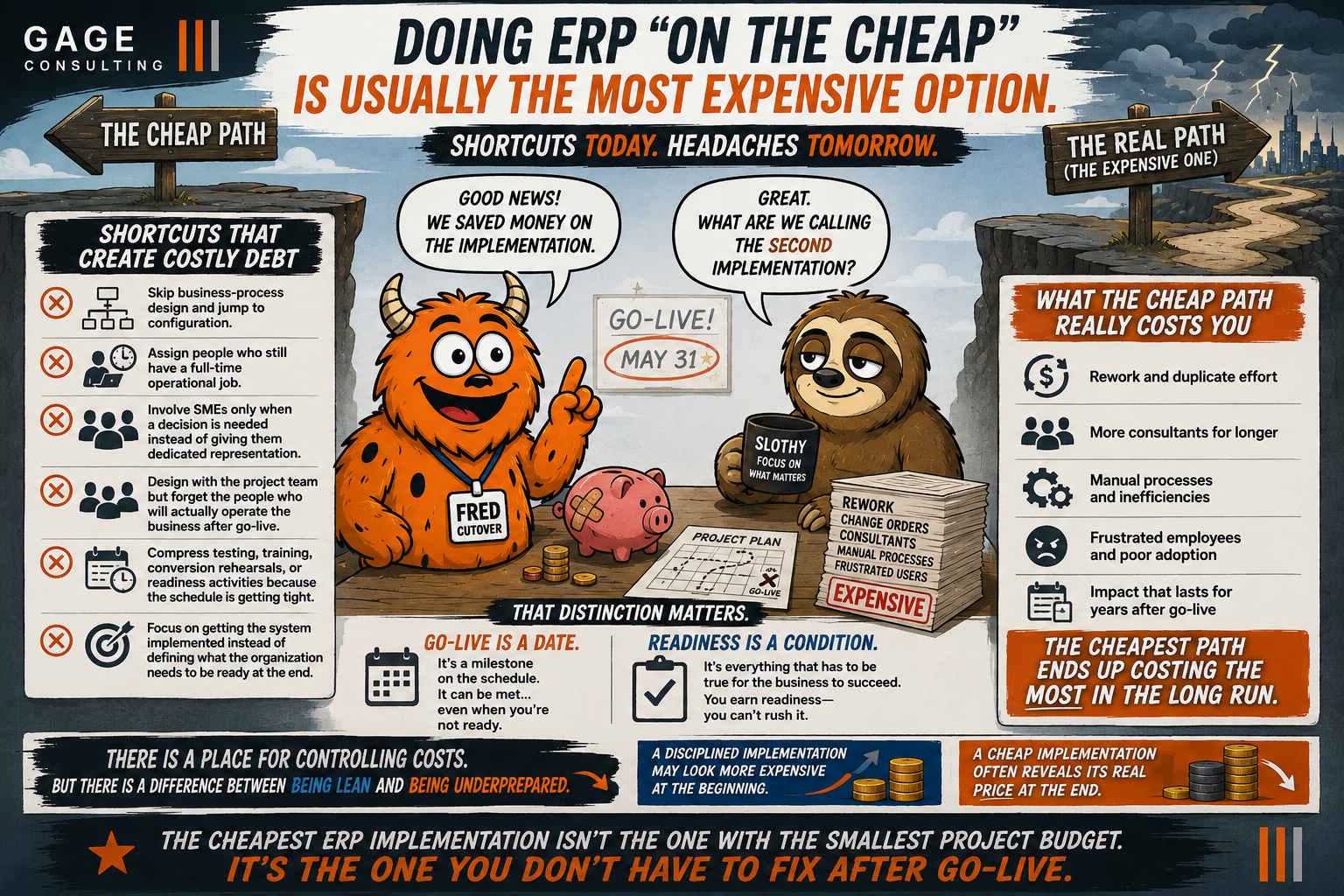
I don’t think the lesson is that ERP implementations need to be expensive.
The lesson is that some things are expensive to skip.
The project can come in under budget—for a while.
You should manage the budget, challenge costs, negotiate where you can, and avoid paying for things that do not add value.
But imagine saving money by skipping the electrical inspection, rushing the foundation work, or deciding not to waterproof the basement. The project might come in under budget. Then you move in.
That is when the inexpensive decision can become the expensive one.
ERP implementations aren’t that different. There are plenty of places to be lean. But the work that determines whether the organization can operate successfully is not simply project expense. It protects the investment you are already making.
Challenge work that does not create value.
- Simplify unnecessary governance.
- Eliminate duplicate deliverables.
- Negotiate tools and outside services.
- Keep the design proportional to the business need.
Invest in what makes the business ready.
- Business-process design and dedicated business participation.
- Data validation and end-to-end testing.
- Training based on the production solution.
- Conversion rehearsals and operational readiness.
A company may spend millions implementing an ERP and then try to save a relatively small amount by asking key business people to participate “when they have time.” The result is not necessarily immediate failure. It may be something much less obvious.
The real cost often appears after the decision.
- 01
A process requires three manual steps nobody anticipated.
- 02
Operations discovers a required report two weeks before go-live.
- 03
A configuration decision has to be redesigned during testing.
- 04
A data problem surfaces that an earlier rehearsal could have found.
- 05
Employees know how to use the system but are not ready to run the business with it.
None of those decisions were unreasonable at the time. They were attempts to control cost. The question implementation teams should ask is different.
Are we reducing the cost of the project—or increasing the cost of owning the outcome?
An ERP isn’t really the investment.
The business’s ability to operate successfully on it is.
Be lean. Challenge the budget. Eliminate work that doesn’t create value. But invest heavily in the things that determine whether the organization will actually be ready.
The goal isn’t the cheapest implementation.
It’s the least expensive path to a successful, sustainable operation after go-live.